



Construction profit margin improvement requires precision estimating, real‑time financial visibility, and disciplined people management. In the Australian construction industry, builders who shift from volume pricing to margin control can protect cash flow and build sustainable profitability, even in volatile markets.
Australian construction margins are under intense pressure. By shifting from volume-based pricing to precision estimating, real-time financial visibility, and people optimisation, builders can protect cash flow and achieve a sustainable 20% profit margin even in today’s volatile market.
Building a profitable construction business in today’s Australian market can feel like pouring a slab in a thunderstorm.
Material costs remain approximately 27% higher than pre-pandemic levels, skilled labour shortages persist, and fixed-price contracts continue to expose builders to risk. As a result, margins as low as 2–5% once tolerated are now commercially unsustainable.
To move from survival to scalability, builders must shift focus. The goal is no longer chasing turnover, but protecting margin through estimating accuracy, cost visibility, and operational discipline.
The Profitability Problem: Why Australian Margins are Under Pressure
One of the biggest margin killers in Australia is the “race to the bottom” in tendering.
In an effort to win work, many contractors submit prices that fail to account for:
- Optimism bias in scheduling
- Underestimated labour productivity
- Unpriced risk and escalation
The solution isn’t working longer hours – it’s estimating smarter and managing risk deliberately.
Tactic 1: Master the “Precision Estimate”
Profitability is decided before construction begins. Your margin is either protected or lost during estimating.
Build-In Trend Buffers
If materials are increasing by 10% annually, adding a 5% escalation buffer on projects starting in six months isn’t padding—it’s professional risk management.
Use Historical Project Data
Review your last five projects. If site cleaning or equipment hire consistently ran 4% over, make that a permanent line item. Guesswork is replaced by empirical data.
Digitise the Takeoff Process
Manual spreadsheets increase the risk of omitted costs. Estimating software improves consistency, reduces human error, and supports 10–20% margin accuracy at scale.
Tactic 2: Agility Through Real-Time Financial Visibility
Fixed-price contracts expose builders when costs spike mid-project.
Real-time job costing and budget tracking allow for course correction, not post-mortem analysis.
If labour overruns appear in week three, adjustments can be made immediately—rather than discovering margin erosion months after completion.
Tactic 3: The “People” Lever in a Tight Labour Market
With labour availability constrained, productivity becomes your competitive advantage.
Cross-Skilling for Efficiency
Multi-skilled team members reduce reliance on costly specialist labour and improve site flexibility.
Faster, Structured Onboarding
A documented onboarding process shortens ramp-up time, improves safety compliance, and accelerates contribution to billable work.
Case Study: How Growth Prop Helped a Builder Achieve a 20% Profit Margin
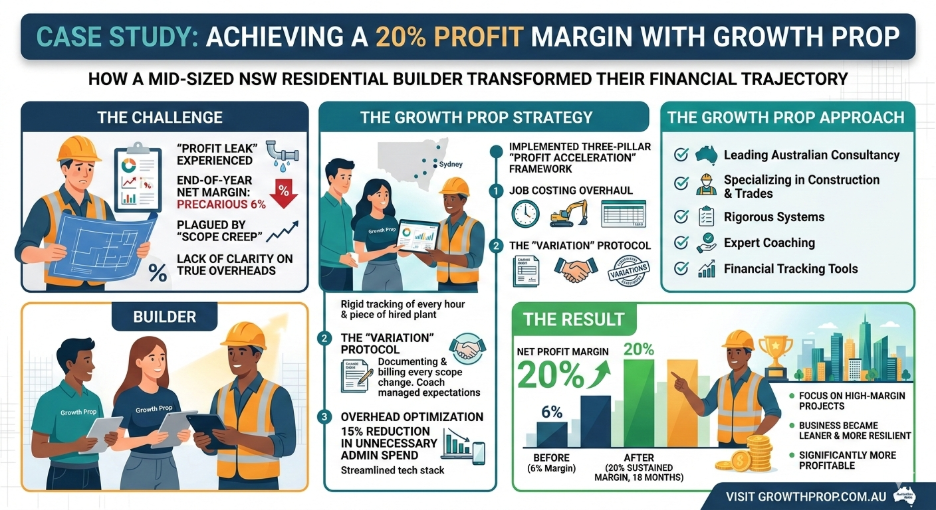
Many Australian construction firms struggle to break the 10% net profit barrier. However, by partnering with Growth Prop, a leading Australian business consultancy specializing in the construction and trade sectors, was able to transform their financial trajectory.
The Challenge: The client was experiencing “profit leak.” Despite a healthy pipeline of work across Sydney and regional NSW, the builder’s net margin sat at 6%. Key issues included:
- Scope creep
- Untracked variations
- Poor overhead visibility
The Growth Prop Strategy: Growth Prop implemented a three-pillar “Profit Acceleration” framework:
Growth Prop implemented a three-pillar Profit Acceleration Framework:
- Job Costing Overhaul
Every labour hour, plant hire, and subcontractor cost was tracked accurately.
- Variation Protocol
Any scope change was priced, documented, and approved—eliminating unpaid “favours”.
- Overhead Optimisation
A full overhead audit reduced unnecessary administration spend by 15%.
The Result
Within 18 months, the business achieved a sustained 20% net profit margin, improved cash flow, and greater project selectivity.
Shifting from “Building Structures” to “Building Wealth”
Improving profit margin in construction requires moving beyond the “she’ll be right” mindset.
Precision estimating, financial visibility, and expert guidance transform volatility into control.
When you commit to a 20% margin standard, you stop building stress—and start building wealth.
Frequently Asked Questions
Q1: What is a good profit margin in Australian construction?
A sustainable net profit margin for well-managed Australian construction businesses is typically 15–20%, accounting for risk, escalation, and overheads.
Q2: Why do construction projects lose money even when priced correctly?
Common causes include optimism bias, unpriced variations, labour inefficiencies, and lack of real-time job costing visibility.
Q3: How can builders protect margins on fixed-price contracts?
Builders can protect margins by using escalation buffers, tracking costs weekly, enforcing variation protocols, and selecting projects strategically.
Q4: Is estimating software worth it for small builders?
Yes. Even small builders benefit from estimating software by reducing overlooked costs and improving pricing accuracy.

